

To say I’ve been unpopular in certain circles for the last three years would be an understatement :)
While major stock indexes were hitting all-time highs and CCaaS vendors were issuing press releases about their “transformative AI capabilities,” I was calling their bluff and predicting a category-wide repricing.
The market has now validated that thesis. What follows is the framework I used and what it says about where the industry actually goes from here.
The Call
In Q1 2023, ChatGPT hype was peaking.
NICE announced ChatGPT integration. Anyone with basic technical literacy could see it was pure marketing.
Five9 teased “game-changing” GPT-powered solutions. RingCentral talked AI on every earnings call. Enterprise Connect was saturated with AI announcements.
Analysts upgraded these stocks on the assumption that generative AI would accelerate cloud migration and increase platform stickiness.
I said to avoid them all. Except Zoom.
The industry laughed and shrugged them off, meanwhile I moved my entire business to ZoomCX in Q3 of 2023 and publicly called my shot.
Here’s how that played out:
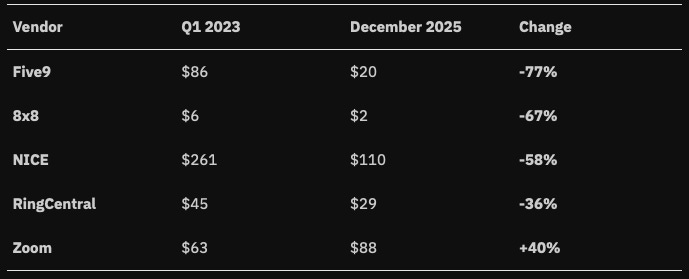
NICE’s market cap fell from roughly $16 billion to $7 billion. Zoom’s increased from roughly $19 billion to $27 billion over the same period.
Digest that for a moment.
The Framework: Four Structural Constraints
I didn’t call this on vibes. I used EthOS.
EthOS is the internal operating system I’ve developed, similar to Koch’s Market-Based Management, but we also apply it externally to evaluate structural risk, capital allocation, and category durability.
When I evaluated CCaaS vendors through that lens, four failures were obvious.
1. Technical Debt from Roll-Up Strategies
When customers publicly refer to NICE CXone as “CX12,” they are accurately describing a problem.
NICE, Five9, RingCentral, 8x8 have all grown through acquisition. That means years of bolting purchased companies together rather than building coherent architecture.
With that level of integration debt, you cannot “add AI.” Every feature becomes a negotiation with past compromises.
Press releases said “AI-powered”.
Engineering reality said unresolved internal dependencies.
Zoom followed a different path. They built infrastructure early, hardened it during the pandemic, and then focused on core CX primitives built on a single architecture. As a result, their development velocity was unmatched.
2. Market Constraints on AI Adoption
While vendors promise AI transformation on investor calls, enterprise reality is governed by different physics.
Healthcare deployments require compliance review and regulatory approval. Financial services procurement cycles routinely exceed a year. Unionized contact centers require negotiation before automation. Fortune 500 change management operates on quarterly cycles.
Actual AI deployment velocity in contact centers is far slower than the timelines implied in earnings calls.
Vendors were selling outcomes their customers could not operationally reach and recognizing revenue on sales cycles that were lengthening.
3. Commoditized AI Eliminated the Moat
This is where the market fundamentally misread the situation.
When a CCaaS vendor announces LLM integration, they are announcing access to the same API available to any startup.
OpenAI, Anthropic, and Google Cloud are commodity suppliers. The API is the API. There is no proprietary intelligence advantage.
For years, incumbents sold complexity as differentiation. Routing logic, IVR tuning, workforce optimization. Generative AI collapses that complexity.
When the hard part becomes easy, pricing power disappears.
4. M&A Exhaustion
The growth model stopped working.
While NICE was busy attributing their YoY growth to AI, I seemed to be the only one doing the math that a lion’s share of it was coming from acquisitions that they were burying, and that they were running out of options for future deals.
The constraints were straightforward:
The market is too concentrated for meaningful acquisitions
Equity currency has been destroyed
Integration capacity is exhausted
They cannot acquire their way forward. Organic growth requires architectural coherence they do not have.
Why Zoom Thrived
Zoom’s outcome was not accidental.
They built CCaaS as a modern system, not as an accumulation of legacy products. No acquisition cleanup. One architecture.
When Zoom integrates AI, it is integrated into a platform rather than layered onto fragmented systems.
Eric Yuan built a platform. The others assembled portfolios.
That distinction is invisible on a balance sheet, but obvious in a constraint analysis. And it’s the difference between -77% and +40%.
The Final Dimension: Leadership
There is an additional layer the numbers don’t capture.
Executives declaring leadership while announcing integrations that did not exist. CEOs repackaging open-source components as proprietary breakthroughs. CTOs celebrating “multi-model strategies” as if that somehow constitutes strategy.
These signals matter. They reflect internal confusion and assume external ignorance.
By contrast, Eric Yuan embodies humility while emphasizing reliability, customer experience, and execution discipline. That posture propagates through his entire organization and creates resilience.
Leadership does not override structural constraints. It determines how organizations behave once those constraints tighten.
What’s Next
The CCaaS valuation collapse was not an anomaly. It was a structural outcome that could be seen years in advance with the right lens.
The next one is already visible.
That is for another post.
Nice article. Only a few companies can finance the infrastructure needed to support a neural network that can comprehend the English language and as you say, everyone else is using an API. So how do they differentiate? CCaaS is essentially a commodity and race to the bottom at this point so they all now get on the micro-services bandwagon and become CPaaS vendors. At the end of the day, businesses with service operations need someone on the inside thinking and experiencing the customer experience from the outside and then changing it. Requires support from the CEO as it's all still mostly deemed a cost center. I can't believe I still have to listen to 'press 1 for...' menus. Healthfirst NY I'm calling you out for a serious level upgrade in your customer experience.